In this first part I was looking for clues and patterns.
There are three possible (planetary) cycles involved
-Ju 11,86 years
-JuSa 9,93 years
-Unknown ~11 year cycle (JuEaVe syzygies?)
So far we can´t say that these three cycles really are involved, but they seem to provide some correlations that needs to be investigated.
Time of sunspot minima and sunspot cycle strength seem to related to these three cycles, in a somewhat complex manner. Not really that complex, but complicated since it is a bit unusual to work with three cycles at the same time.
But IF these planetary cycles really are involved, we don´t know how....
Anyway, this is the table summing up the major caracteristics of the sunspot cycles so far.
Later I will try to reconstruct the sunspotcycles back to year 1600, try to explain the Maunder minimum, and make a forecast for the rest of the century or longer...
Planetary influence on the sunspot cycle
Wednesday, April 24, 2019
Monday, April 22, 2019
The ~11 year cycle (Jupiter-Earth-Venus syzygies?)
So far I haven´t brought in the ~11 year cycle.
Does it excist? Do we "need" it?
Why was SC4 such a long lasting cycle? Why was SC23 a long cycle?
What causes the sunspot minima to "break out of" type B and into type C?
Background link: http://jpdesm.pagesperso-orange.fr/sunspots/
-------------------------------
So let´s say there is a 11,08 year cycle (11 years 1 month).
What is the variation of sunspot minimum versus the ideal/average time given from a 11,08 year cycle?
This could suggest there are limitations to how early or how late a sunspot minimum can be versus the 11,08 year cycle.
-SC4 had a very early minimum/start, therefore SC5 had to start at least 11,08 years later. So SC4 was prevented from being a short cycle
-SC15 was late, and it had to be a short cycle less that 11,08 years.
-SC23 started early and had to be a long cycle.
These three sunspot cycles were turingpoints.
-up to SC4 the cycles were generally short
-SC4 to SC14 were generally long
-SC15 to SC22 were generally short
-SC23 and the coming cycles will generally be long
So after a series of short cycles we get an extended cycle that causes an JuSa-OFF cycle (SC5 and SC24).
And after a series of long cycles, that end up in the favorable B-type, we get a short cycle that forces into C-type.
I will sum up all this in a table...
Does it excist? Do we "need" it?
Why was SC4 such a long lasting cycle? Why was SC23 a long cycle?
What causes the sunspot minima to "break out of" type B and into type C?
Background link: http://jpdesm.pagesperso-orange.fr/sunspots/
-------------------------------
So let´s say there is a 11,08 year cycle (11 years 1 month).
What is the variation of sunspot minimum versus the ideal/average time given from a 11,08 year cycle?
This could suggest there are limitations to how early or how late a sunspot minimum can be versus the 11,08 year cycle.
-SC4 had a very early minimum/start, therefore SC5 had to start at least 11,08 years later. So SC4 was prevented from being a short cycle
-SC15 was late, and it had to be a short cycle less that 11,08 years.
-SC23 started early and had to be a long cycle.
These three sunspot cycles were turingpoints.
-up to SC4 the cycles were generally short
-SC4 to SC14 were generally long
-SC15 to SC22 were generally short
-SC23 and the coming cycles will generally be long
So after a series of short cycles we get an extended cycle that causes an JuSa-OFF cycle (SC5 and SC24).
And after a series of long cycles, that end up in the favorable B-type, we get a short cycle that forces into C-type.
I will sum up all this in a table...
Sunspot cycle strength
So the JuSa analysis show that cycles are divided into weak OFF-cycles, and strong ON-cycles.
But there is a big span in strength within the ON-cycles... can we find another useful correlation?
I bring back the Ju-angle vs strength diagram
-but I leave out the OFF-cycles
-and I have shifted the data by 270 deg
1-we can see a possible linear relationship between angle and strength within the A and B types, and also within the C-type.
2-And again we see that something is going on (deviating) in SC7 and SC20.
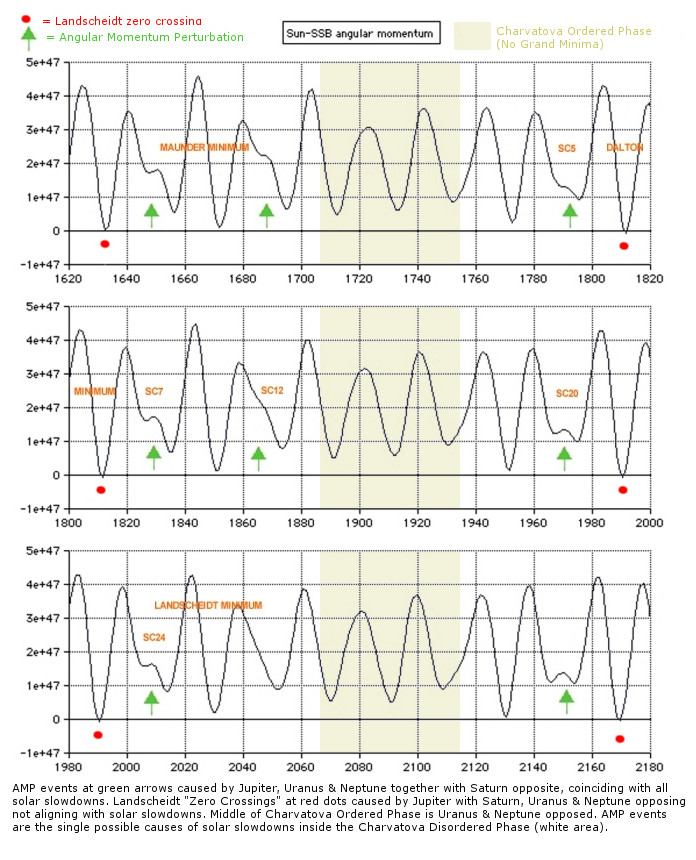
I will look into SC7 and SC20 later. Remember that this analysis has left out any influence from Uranus and Neptune, and assuming circular orbits. We could see a possible explanation in this diagram:
http://www.landscheidt.info/images/sunssbam1620to2180gs.jpg
Finally I also show the OFF-cycles (here I have not shifted the x-axis by 270 deg)
But there is a big span in strength within the ON-cycles... can we find another useful correlation?
I bring back the Ju-angle vs strength diagram
-but I leave out the OFF-cycles
-and I have shifted the data by 270 deg
1-we can see a possible linear relationship between angle and strength within the A and B types, and also within the C-type.
2-And again we see that something is going on (deviating) in SC7 and SC20.
I will look into SC7 and SC20 later. Remember that this analysis has left out any influence from Uranus and Neptune, and assuming circular orbits. We could see a possible explanation in this diagram:
http://www.landscheidt.info/images/sunssbam1620to2180gs.jpg
Finally I also show the OFF-cycles (here I have not shifted the x-axis by 270 deg)
The synodic Jupiter-Saturn cycle 19,85 years
Stars wobble, and Jupiter is the main contributor in our system followed by Saturn.
There are many theories on such/similar influence on the sunspot cycle, focusing on barycentre, angular momentum, torque and so on. Geoff Sharp has summed some up at landscheidt.info
I will make a simplyfied analysis only looking at Jupiter and Saturn, and disregarding orbital eccentricity. Also I make the assumption that the smoothed maximum ISN is a useful measure of the sunspot cycle strength.
First the heliocentric angle between Jupiter and Saturn at solar minimum, and the corresponding ISN of the cycle.
If we assume that conjunctions and oppositions of Jupiter-Satrun can be treated equally, we can compress this data into 0-180 degrees (and a 9,93 year cycle).
We observe that when JuSa-angle is ~20-100 degrees at solar minimum, we get strong sunspot cycles (ON). Otherwise we get weak cycles (OFF).
There is a change in behaviour at 105 degrees, and the OFF-sector is divided in two. If we shift this data 105 degrees, we get a clearer picture:
There are some weak ON-cycles marked by dotted line. We have to look at those later.
Next step is looking at where the type A, B and C-cycles lie in this chart.
First the B-type. Looks "OK"
Then the C-type. Notice that the ON-cycles tend to be weak. And so far no OFF-cycles.
Finally the A-cycles:
1-The A-OFF cycles look very weak.
2-The A-ON cycles look very strong
3-But there are two A-ON cycles that are surprisingly weak (SC7 and SC20). Must investigate those two later.
There are many theories on such/similar influence on the sunspot cycle, focusing on barycentre, angular momentum, torque and so on. Geoff Sharp has summed some up at landscheidt.info
I will make a simplyfied analysis only looking at Jupiter and Saturn, and disregarding orbital eccentricity. Also I make the assumption that the smoothed maximum ISN is a useful measure of the sunspot cycle strength.
First the heliocentric angle between Jupiter and Saturn at solar minimum, and the corresponding ISN of the cycle.
If we assume that conjunctions and oppositions of Jupiter-Satrun can be treated equally, we can compress this data into 0-180 degrees (and a 9,93 year cycle).
We observe that when JuSa-angle is ~20-100 degrees at solar minimum, we get strong sunspot cycles (ON). Otherwise we get weak cycles (OFF).
There is a change in behaviour at 105 degrees, and the OFF-sector is divided in two. If we shift this data 105 degrees, we get a clearer picture:
There are some weak ON-cycles marked by dotted line. We have to look at those later.
Next step is looking at where the type A, B and C-cycles lie in this chart.
First the B-type. Looks "OK"
Then the C-type. Notice that the ON-cycles tend to be weak. And so far no OFF-cycles.
Finally the A-cycles:
1-The A-OFF cycles look very weak.
2-The A-ON cycles look very strong
3-But there are two A-ON cycles that are surprisingly weak (SC7 and SC20). Must investigate those two later.
Sunday, April 21, 2019
The Jupiter supercycle
So when looking at the timing of solar minimum and the corresponding heliocentric angle of Jupiter, we find a supercycle of ~180 years.
Here are the two known supercycles shown, with the Jupiter angle relative to the zero-position.
Type A-B-C are shown with colors.
I have also made a rough forecast (without any explanation at this point)
Here are the two known supercycles shown, with the Jupiter angle relative to the zero-position.
Type A-B-C are shown with colors.
I have also made a rough forecast (without any explanation at this point)
Jupiter - the Jovian cycle 11,86 years
Jupiter is by far the most important influencer on the sunspot cycle.
Late Timo Niroma did a lot of work on this.
I start with the list of sunspot cycles.
At each sunspot minimum I have retrieved the planetary positions. For quick lookups I often use Asynx Planetarium, but here I used an excel spreadsheet that I got from a french colleague a long time ago. I will find his name and credit him in a comment, and also upload the spreadsheet so you can use it.
So the first thing to look at is the Jupiter (heliocentric) position at solar minimum.
The minima are clustered in three intervals, marked with A, C and B.
I chose this order/colors a long time ago and have sticked with it.
This is what the list looks like (color identifies what interval the minima belongs to).
It showns how the minima go from C to A to B to C.... and so on (with an exception in SC5).
Introduction
Welcome. Let me present some of my work on the sunspot cycle. I will start very simple, just looking at the dates of sunspot minimum and the cycle strength. Later I´ll dig into montly and daily data, planetary ephemerides, and probably some tidal force calclulations and so on.
The central part here is obviously the planetary influence on the sunspot cycle.
Some 15 years ago I read about superflares on distant stars, where giant planets or twin stars were involved in creating such flares. So I realized the neighbours were influencing the star/solar activity.
So when looking into our sunspot cycle, we can quickly find a major pattern in the timing of the cycles. And a major pattern in the sunspot cycle strength. Next we have to explain some details. But the final explanation of what is really going on... maybe we can see some traces of that too...
Lets go!
The central part here is obviously the planetary influence on the sunspot cycle.
Some 15 years ago I read about superflares on distant stars, where giant planets or twin stars were involved in creating such flares. So I realized the neighbours were influencing the star/solar activity.
So when looking into our sunspot cycle, we can quickly find a major pattern in the timing of the cycles. And a major pattern in the sunspot cycle strength. Next we have to explain some details. But the final explanation of what is really going on... maybe we can see some traces of that too...
Lets go!
Subscribe to:
Posts (Atom)